

Best Cat Enrichment Toys for Small Spaces: 2026 Guide
Table of Contents
- Why Small-Space Cats Need Enrichment Toys More Than Ever
- Quick Comparison: Best Cat Enrichment Toys for Small Spaces
- Interactive Cat Toys for Indoor Cats: Motion and Chase
- Puzzle Feeders for Cats: Slow Feeding and Problem-Solving
- Cat Toys for Mental Stimulation: Brain Games That Fit on a Shelf
- Indoor Cat Enrichment Ideas: Scratching, Climbing, and Sensory Play
- Safety, Noise, and Storage: What Small-Space Owners Should Know
- Conclusion: Building a Rotation That Works in Your Space
- Frequently Asked Questions
Last Updated: October 12, 2026
Why Small-Space Cats Need Enrichment Toys More Than Ever
A studio-apartment cat has the same hunting instincts as a barn cat but roughly one percent of the territory.
Cat enrichment gives an indoor cat outlets for natural behaviors, hunting, chasing, scratching, climbing, problem-solving, through toys, feeders, and furniture.
Most guides treat enrichment as a shopping list: buy a wand, buy a puzzle, done. A 400-square-foot apartment needs a rotation, not a pile.
Quick Comparison: Best Cat Enrichment Toys for Small Spaces
The table below summarizes our top picks by category, footprint, and price.
| Toy | Category | Footprint | Price | Best For |
|---|---|---|---|---|
| VKTECH Interactive Ball Toy | Motion and chase | 65 × 56 × 56 mm | $20.99 | Solo play under a desk |
| Two Tier Modern Cat Tree Tower | Climbing | 15.5" x 15.5" x 19" | $113.99 | Corner climbing and napping |
| PAWZ Road Flower Cat Bed Scratcher | Scratching and lounging | Two-tier, ~50 cm tall | $53.99 | Cat trees in tight corners |
| PAWZ Road Cactus Scratcher Post | Scratching | Rounded base, 3 poles | $47.99 | Vertical stretching |
| NONECN 2-in-1 Wood Scratcher | Scratching and chasing | 1-tier, lightweight | $43.99 | Furniture protection |
| Cat Hammock Sofa 2-in-1 | Rest and scratch | Compact, floor-level | $43.99 | Lounging plus scratching |
| Bone Type Cardboard Board | Scratching | Single-layer, flat | $57.99 | Under furniture edges |
| PAWZ Road Tall Sisal Post | Scratching and play | 32" tall, 42 x 25 x 18 cm box | $51.99 | Full-height scratching |
What to Look For in a Small-Space Cat Toy
Five criteria decide whether a toy earns its floor space. Footprint: measure the spot before you buy. Noise: hard plastic wheels are loud on bare floors; a mat helps. Storage: collapsible or flat items pack away. Durability and cleaning: washable covers matter where odors concentrate. Supervision: put away anything with strings, cords, or small detachable parts when you're not watching.

Interactive Cat Toys for Indoor Cats: Motion and Chase
Our pick here is the VKTECH Cat Interactive Ball Toy at $20.99.
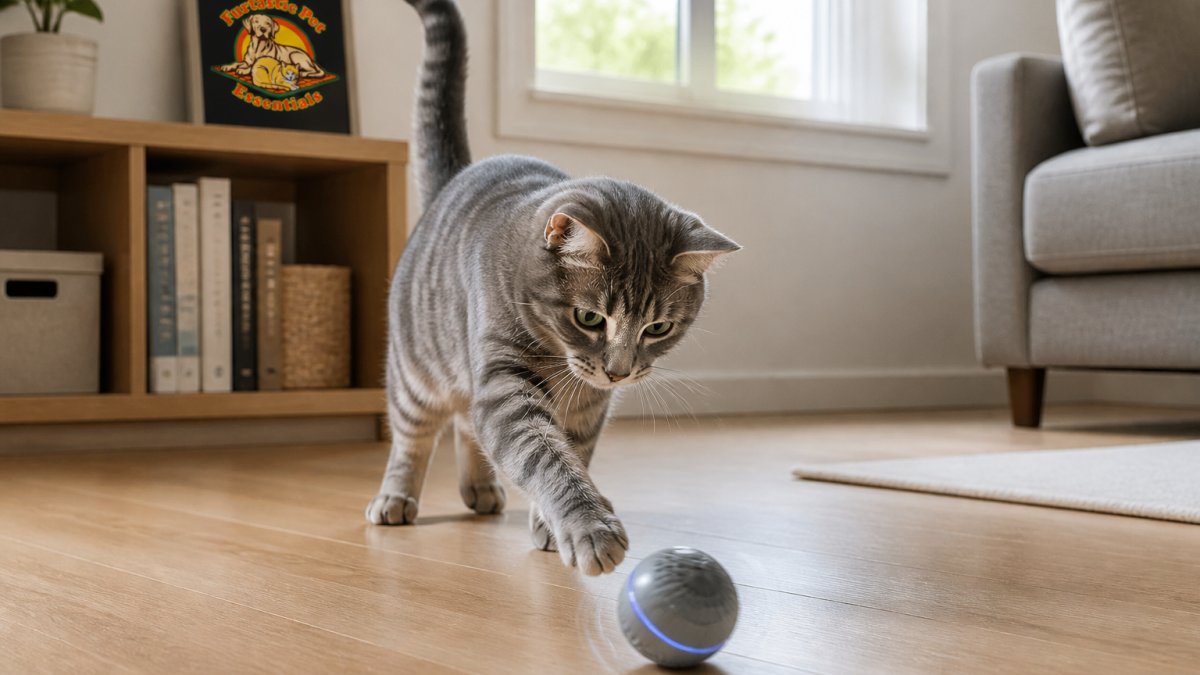
Footprint and clearance. A rolling ball needs a runway: roughly a 3-foot-by-3-foot clear patch with no rug fringe, cords, or escape gap under a door.
Noise by flooring. On hardwood or laminate, rolling is audible from the next room; a low-pile rug or yoga mat cuts the sound noticeably.
Match the toy to the cat, not the trend.
- Kittens and young adults: fast, erratic motion and wand play with quick direction changes. Short sessions, several times a day.
- Middle-aged cats: rolling balls and treat-dispensing motion toys that reward a catch.
- Seniors and less mobile cats: slow-rolling or stationary toys placed within easy reach, plus floor-level wand play. Skip anything that requires jumping or a long chase.
Supervision and storage. Battery-powered rolling toys are generally safe for solo play, but check the battery compartment is screwed shut and the shell isn't cracked. String, ribbon, or feather attachments come out only when you're watching. Store motion toys in a drawer or bin between sessions.
Puzzle Feeders for Cats: Slow Feeding and Problem-Solving
Puzzle feeders for cats turn a two-minute meal into a ten-minute foraging session, the closest thing to a natural hunting cycle an indoor cat gets.
Start easy: a cat new to food puzzles gives up if the first one is too hard.
- Beginner: shallow tray puzzles with wide channels
- Intermediate: rolling treat dispensers that release food as the cat bats them
- Advanced: multi-step puzzles with drawers, flaps, and levers
- Foraging: a snuffle mat or scattered kibble across a towel
Difficulty matters more than brand. A puzzle your cat solves in thirty seconds has stopped being enrichment and become a bowl with extra steps.
Cat Toys for Mental Stimulation: Brain Games That Fit on a Shelf
Cat toys for mental stimulation require a decision, not just a reflex. Batting a ball is exercise; figuring out how to get a treat out of a drawer is cognition, and it tires a cat faster.
The NONECN 2-in-1 Wood Scratcher and Ball Toy at $43.99 combines both: a solid wood frame and sisal scratching board with a natural paper ball, and hollow cavities that invite a cat to reach and explore rather than just swipe.
Mental and physical fatigue are different. A cat that chased a laser for twenty minutes may still be wound up because the hunt never ended in a catch. Puzzle feeding gives the sequence a finish line.
Indoor Cat Enrichment Ideas: Scratching, Climbing, and Sensory Play
Indoor cat enrichment ideas only work if they cover three needs: scratching, vertical space, and sensory variety. Skip one and the cat redirects to your sofa, counters, or shoelaces.
Scratching first, because it's non-negotiable. The PAWZ Road Cactus Scratcher Post at $47.99 offers three sisal-wrapped poles from 7.5" to 20.9" for a full stretch, plus a dangling ball.
VKTECH Cat Interactive Ball Toy SelfRotating Rechargeable Indoor Cat Toy →
For a flat option that slides under furniture edges, the Bone Type Corrugated Cardboard Scratching Board at $57.99 is a single-layer wooden board that flips as it wears and is made without high-concern chemicals.
Vertical space is the other half. A Two Tier Modern Cat Tree Tower at $113.99 measures just 15.5" x 15.5" x 19", holds up to 33 lbs, and adds a top perch, a four-step ladder, a jingling ball, and sisal posts in one corner-sized footprint. For something shorter and softer, the PAWZ Road Flower Cat Bed Scratcher at $53.99 pairs a removable flower bed with a mushroom-shaped scratcher and a pom-pom toy, standing about 50 cm tall.


Sensory play rounds it out: catnip, silvervine, and texture variety. The Cat Hammock Sofa 2-in-1 at $43.99 has a 100% linen lounging cover and a sisal scratch area, so rest and scratching share one compact piece.
Safety, Noise, and Storage: What Small-Space Owners Should Know
Safety, noise, and storage are what small-space cat owners underestimate most, and what most guides skip. Here's the concrete version.
Footprint and clearance: measure the spot, not the toy
A product's listed dimensions are the toy at rest; the space it needs is larger.
- Scratching posts: add roughly 6 inches of clearance on all sides so a cat can stretch and lean without hitting a wall. A 15-inch-square base effectively occupies a 27-inch-square zone.
- Cat trees: the base is the anchor, but a cat launching off the top perch needs a landing zone in front. Leave at least 2 feet of open floor on the jump-down side.
- Rolling and motion toys: plan on a 3-foot-by-3-foot clear patch. They will find the gap under the sofa.
- Flat scratching boards: the small-space cheat code. A single-layer board slides under a sofa edge or against a baseboard and adds almost no occupied floor.
Storage: what packs away and what doesn't
Small-space living rewards items that disappear between uses.
- Wands: hang on a hook inside a closet door or coil into a drawer. Near-zero storage cost.
- Flat boards: slide behind a sofa or stand upright in a closet.
- Collapsible play tunnels: fold flat; check folded dimensions before buying, since some "collapsible" tunnels still take up a shelf.
- Motion toys: a single lidded bin holds the whole rotation, kept out of sight so the cat never sees the same five toys at once.
Noise: the neighbor question
Hard toys on hard floors are the main culprit. Felt pads under posts and a mat under rolling balls cut sound dramatically. If you live above a neighbor, keep motion toys to daytime hours and prefer carpet or a rug. A wide, weighted-base post is quieter than a lightweight one that skitters mid-scratch.
Safety and supervision
The American Veterinary Medical Association advises keeping string, ribbon, and cord toys out of reach when unsupervised, since swallowed linear material can cause serious internal injury. Practical rules for a small space:
- Strings and cords: wand toys and dangling attachments are supervised-play only. Put them away, don't just drop them.
- Detachable parts: check weekly for loose bells, frayed rope, and cracked plastic. Small parts are a choking risk.
- Batteries: confirm the compartment is screwed shut and the shell isn't cracked. Charge rechargeable toys out of the cat's reach.
- Laser play: always end a laser session with a physical toy the cat can actually catch, or the hunt never finishes and the cat stays wound up.
Durability, cleaning, and ongoing cost
Small spaces concentrate odors, so washable materials matter more than in a big house.
- Sisal: vacuum with a brush attachment, not a wet cloth. Moisture breaks down the rope and shortens the post's life.
- Plush and fabric covers: look for removable, machine-washable covers. A cover you can't wash becomes a cover you replace.
- Cardboard boards: flip them as they wear; replace when the corrugation flattens. Cheap to replace, but they do wear out.
- Battery and charging needs: rechargeable toys avoid ongoing battery costs but need a cable and a charging spot. Disposable-battery toys are cheaper up front and more expensive over a year.
Conclusion: Building a Rotation That Works in Your Space
You can't buy your way out of small-space cat ownership. One perfect toy won't replace territory, but a deliberate rotation of five or six items across scratching, climbing, motion, and foraging will.
That's the approach at Furtastic Pet Essentials. Our catalog covers the categories this rotation needs, from compact cat trees and sisal posts to rechargeable motion toys, backed by fast, friendly service.
Frequently Asked Questions
How can I entertain a cat in a small apartment?
Rotate a few compact toys instead of leaving everything out at once. A rechargeable ball toy like the VKTECH Cat Interactive Ball Toy ($20.99) rolls on its own for independent play, while a wand session gives you direct bonding time. Puzzle feeders add a food-based challenge. Even 10 to 15 minutes of focused play twice a day can make a noticeable difference in a small space.
What are the best cat enrichment toys for small spaces?
Look for toys that store flat or tuck under furniture. The NONECN 2 In 1 Solid Wood Cat Scratcher ($43.99) combines a sisal board and a paper ball in one footprint. A rechargeable interactive ball like the VKTECH ($20.99) needs no wand storage. The Cat Hammock Sofa 2-In-1 ($43.99) saves floor space by pairing a lounging hammock with a sisal scratch area.
Are interactive toys good for indoor cats?
Yes. Interactive toys trigger hunting instincts like chase, pounce, and batting. A self-rotating ball such as the VKTECH Cat Interactive Ball Toy ($20.99) provides motion and unpredictability that keeps cats engaged. These toys also support exercise and weight management, which matters more for indoor cats that do not roam outside. Supervise battery-powered toys and check for wear regularly.
How much playtime does an indoor cat need each day?
Most indoor cats benefit from two or three short play sessions daily, totaling about 20 to 30 minutes. A 10-minute wand session in the morning and a puzzle feeder at night can cover both physical and mental needs. For busy days, a rechargeable ball toy like the VKTECH ($20.99) offers independent play. Adjust based on your cat's age, mobility, and energy level.
What cat enrichment activities take up very little space?
Scratching posts, puzzle feeders, and small interactive balls are the easiest to fit in tight areas. The PAWZ Road Cactus Cat Scratcher ($47.99) has a rounded base and three poles that take up less than a square foot. The Bone Type Corrugated Cardboard Scratching Board ($57.99) is single-layer and can slide under a sofa. Rotate toys weekly to keep novelty high without adding clutter.
Small spaces demand smarter choices, not more stuff. Furtastic Pet Essentials carries durable, space-conscious cat furniture and toys, including compact cat trees, sisal scratching posts, and rechargeable interactive toys, all in one place with customer service that responds when something goes wrong. Build a rotation that fits your floor plan and your cat's instincts. Search Furtastic Pet Essentials to find the right starting pieces.