

How to Choose the Right Cat Tree: 2026 Buyer's Guide
Table of Contents
- Quick Comparison: Top Cat Trees for Every Home
- Assessing Cat Size and Weight Before You Buy a Cat Tree
- Stability and Structural Integrity: The Wobble-Free Test
- Choosing the Best Cat Tree for Large Cats
- Materials and Vertical Space: Sisal, Solid Wood, and Climbing Needs
- Cat Tree Placement Tips for Small Spaces and Multi-Cat Homes
- When a Cat Scratching Post Looks Like a Tree: Style Meets Function
- Frequently Asked Questions
Last Updated: September 30, 2026
Quick Comparison: Top Cat Trees for Every Home
Choosing the right cat tree means matching base dimensions, weight capacity, and material durability to your cat's size and your room's layout.
Below, we'll show you how to evaluate stability, materials, and placement so your cat actually uses what you buy.
| Model | Height | Weight Capacity | Best For | Price |
|---|---|---|---|---|
| HOOMIC Multi-Level Cat Tree Tower | 65 in | 33 lb | Multi-cat households, large cats | $139.99 |
| PAWZ Road Large Cat Tree Indoor | 41 in | Not listed | Large cats, seniors | $85.99 |
| PAWZ Road 5-Tier Floor-to-Ceiling | 94-108 in | Not listed | Apartments, vertical climbers | $69.99 |
| PEQULTICN Cat Tree for Indoor Cats | 41 in | Not listed | Kittens and seniors together | $80.99 |
| JHK Cat Tree Tall Multi-Cat | 44 in | 44 lb | Multi-cat homes, budget buyers | $60.99 |
Assessing Cat Size and Weight Before You Buy a Cat Tree
The biggest mistake is underestimating your cat's adult weight and length. A cat that fits a compact tower at six months will outgrow it by eighteen months, and a wobbly platform teaches a cat to avoid the tree entirely.

Weigh your cat and measure from nose to tail base. For cats over 15 pounds, look for a weight capacity of at least 30 pounds and a base plate wider than 20 inches.
Stability and Structural Integrity: The Wobble-Free Test
Stability is the first thing to test and the last thing most buyers check. A cat tree that shifts even slightly under a jump will be abandoned within days.

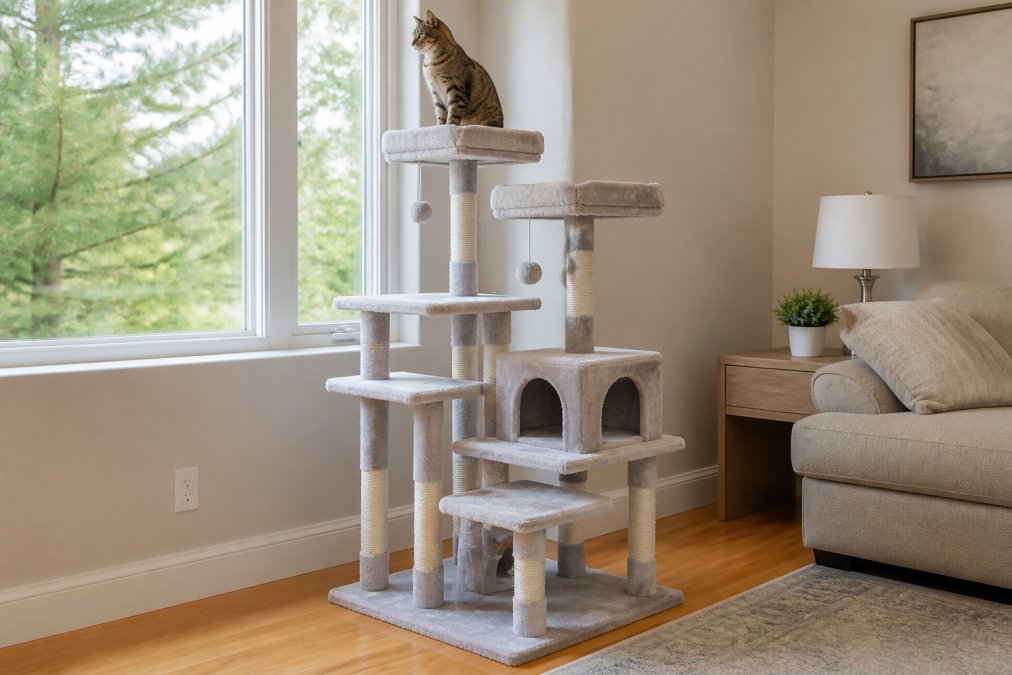
Choosing the Best Cat Tree for Large Cats
The best cat tree for large cats combines a wide base, thick sisal posts, and platforms sized to the cat's full body length. Maine Coons, Ragdolls, and other large breeds need perches at least 15 inches across.
Materials and Vertical Space: Sisal, Solid Wood, and Climbing Needs
Material choice determines how long the tree lasts, whether your cat scratches it, and what it off-gasses into your home. Most guides stop at "sisal is good, carpet is bad." The real decision is a trade-off matrix.
Scratching surfaces, ranked by durability:
- Natural sisal rope, the gold standard. Tightly wound, 3/16-inch to 1/4-inch rope resists fraying and gives cats the resistance they need to shed claw sheaths. Look for full-post wrapping, not a decorative patch.
- Sisal carpet, softer and cheaper, but cats can pull loops loose. Better for lounging than scratching posts.
- Corrugated cardboard, replaceable and cheap, but it sheds and compresses. Fine as a supplement, not a primary post.
- Berber or loop-pile carpet, durable but can snag claws. Some cats refuse it entirely.
Frame materials:
-
Solid wood (pine, plywood core), heaviest and most stable, resists warping, and holds screws tight through years of jumping. The trade-off is cost and weight.
-
Engineered wood / particleboard, lighter and cheaper, but screws can strip if the tree is disassembled and rebuilt. Look for a sealed finish to prevent moisture swelling.
-
MDF, smooth and paint-friendly, but heavy and prone to crumbling at screw points.
-
Formaldehyde-free adhesives (often labeled "E0" or "no-added-formaldehyde")
-
Water-based, low-VOC finishes rather than solvent-based lacquers
-
Recycled or FSC-certified wood where the manufacturer discloses sourcing
-
Replaceable sisal sleeves so you re-wrap posts instead of replacing the whole tree, the biggest way to cut long-term waste
- Climbing, staggered platforms 12-18 inches apart let cats ascend without a running start. Gaps wider than 24 inches force a leap older or heavier cats may refuse.
- Surveying, a top perch at or above human eye level (roughly 5-6 feet) gives a cat a vantage point. This is the perch cats fight over in multi-cat homes.
- Retreating, a covered condo at mid-height offers a hiding spot that still feels elevated. Floor-level hideaways get used less because they feel exposed.
Cat Tree Placement Tips for Small Spaces and Multi-Cat Homes
Placement decides whether a cat tree gets used or ignored, and in a small space, whether it looks like furniture or clutter.
HOOMIC Multi-Level Cat Tree Tower With →
The three placement rules that actually matter:
- Put it where your cat already is. Watch your cat for two days and note where it naps, perches, and watches the room. A tree in that spot gets used within hours; one in a "logical" empty corner gets ignored for weeks.
- Give it a view. Cats want to watch something, a window, doorway, or hallway. A tree facing a blank wall will be abandoned.
- Keep the approach path clear. Cats need a runway to jump up. At least 18-24 inches of clear floor in front of the lowest platform lets a cat commit to the jump. Blocked approaches are the #1 reason cats ignore otherwise-fine trees.
Small-space placement, by room type:
-
Studio apartments, a floor-to-ceiling tension pole in a corner uses vertical space instead of floor space. Pair it with a wall-mounted shelf or two at staggered heights to create a climbing route without a second footprint.
-
Bedrooms, place the tree near but not against the bed. Cats like to perch above where you sleep, and a tree at the foot of the bed satisfies that instinct without taking floor space.
-
Living rooms, the corner nearest the window is the highest-value real estate in the home. If your TV is there, move the tree to the opposite corner and angle it toward the window.
-
Home offices, a tree beside your desk gives your cat a "supervising" perch. A shorter tree (36-48 inches) works better here, because the cat wants to be at your eye level, not above it.
-
Match the wood tone to your existing furniture. A walnut-toned tree in a room full of oak reads as an accident. Neutral beige, gray, and natural wood tones blend into most palettes.
-
Choose a silhouette that reads as decor. Cactus, branch, and geometric shapes look intentional; traditional carpeted towers look like pet-store inventory.
-
Use the tree to solve a design problem. A tall tree fills a bare corner's visual dead space, and a tree with a condo hides an outlet or router.
If your cat ignores the tree, troubleshooting checklist:
- Move it. Relocation fixes more disinterest than any other change. Try the spot your cat already naps in.
- Rub it with a familiar scent. A cloth your cat sleeps on, tucked into the condo, speeds acceptance.
- Lure with treats and play. Place treats on each level and drag a wand toy up the posts. Most cats convert within a week.
- Check stability. A wobbly tree gets abandoned. Anchor it to the wall and re-test.
- Check the approach. If the cat must jump from a slippery floor or tight angle, add a small step or mat.
- Give it time. Some cats take two to three weeks to adopt new furniture.
When a Cat Scratching Post Looks Like a Tree: Style Meets Function
A cat scratching post looks like a tree when it combines a natural sisal surface with vertical structure and a perch on top. These designs blend into living rooms better than traditional carpeted towers.
Frequently Asked Questions
What features should I look for in a high-quality cat tree?
Focus on a wide base plate and solid frame for stability, natural sisal rope on scratching posts, and plush or faux fur perches for comfort. Check the weight capacity to ensure it supports your cat's size, and look for anchoring straps or wall-mount options to prevent tipping. Easy-to-clean materials and replaceable covers extend the life of the cat tree.
How tall should a cat tree be for an indoor cat?
Most indoor cats do well with a cat tree that is at least 40 to 50 inches tall, but taller is often better. A floor-to-ceiling tension pole model that adjusts from 94 to 108 inches gives cats a high vantage point, which supports climbing behavior and helps them feel secure. Just make sure the base is heavy enough to keep the tower stable at full height.
How do I choose a cat tree for a multi-cat household?
Look for a multi-level design with at least two condos, multiple perches, and a hammock so each cat can claim its own space. A weight capacity of 33 to 44 pounds or more supports several cats at once. Also check for a wide base and anti-tip straps, since more cats means more jumping and landing force on the structure.
Where is the best place to put a cat tree in my home?
Place the cat tree near a window so your cat has something to watch, but avoid blocking walkways or heaters. In small apartments, a corner placement saves floor space and gives the tree extra wall support. If you have a senior cat, put a lower platform or ramp near the bottom so it can climb without jumping too high.
Do cat trees help with cat behavior and enrichment?
Yes. A cat tree gives indoor cats a dedicated outlet for climbing, scratching, and perching, which can reduce furniture damage and boredom. Multi-level towers with sisal posts and hideaways support natural instincts like scratching and watching from a high vantage point. Cats that get daily vertical exercise tend to be more relaxed and less destructive.
What materials are best for cat tree scratching posts?
Natural sisal rope is the top choice because it is durable and satisfies a cat's urge to scratch without shredding quickly. Avoid carpet-covered posts if your cat is a heavy scratcher, since carpet fibers can loosen and get ingested. Solid wood or eco-friendly particleboard frames add stability, and plush or faux fur covers make perches comfortable for lounging.