

How to Train a Dog in an Apartment: 7-Step Guide
Table of Contents
- Step 1: Set Up Your Apartment for Training Success
- Step 2: Potty Training a Puppy in an Apartment
- Step 3: Apartment Dog Barking Solutions That Work
- Step 4: Indoor Dog Exercise Ideas for Small Spaces
- Step 5: Crate Training and Urban Etiquette in Shared Spaces
- Step 6: Landlord Policies, Neighbor Conflicts, and Apartment Dog Training
- Frequently Asked Questions
Last Updated: September 29, 2026
Step 1: Set Up Your Apartment for Training Success
Learning how to train a dog in an apartment starts with the space itself, not the dog. A small home has no yard to fall back on, so you have to build a training zone on purpose.
Start with these basics:
- Pick one potty spot near the door and never move it
- Clear a small training corner free of clutter
- Keep treats, a leash, and cleaning spray within arm's reach
- Block off rooms you cannot supervise yet
- Cut hallway noise by moving the crate away from the front door
Step 2: Potty Training a Puppy in an Apartment
Potty training a puppy in an apartment comes down to one rule: the dog never gets free run of the place until it has earned it. That means a leash, a schedule, and your full attention for the first few weeks.
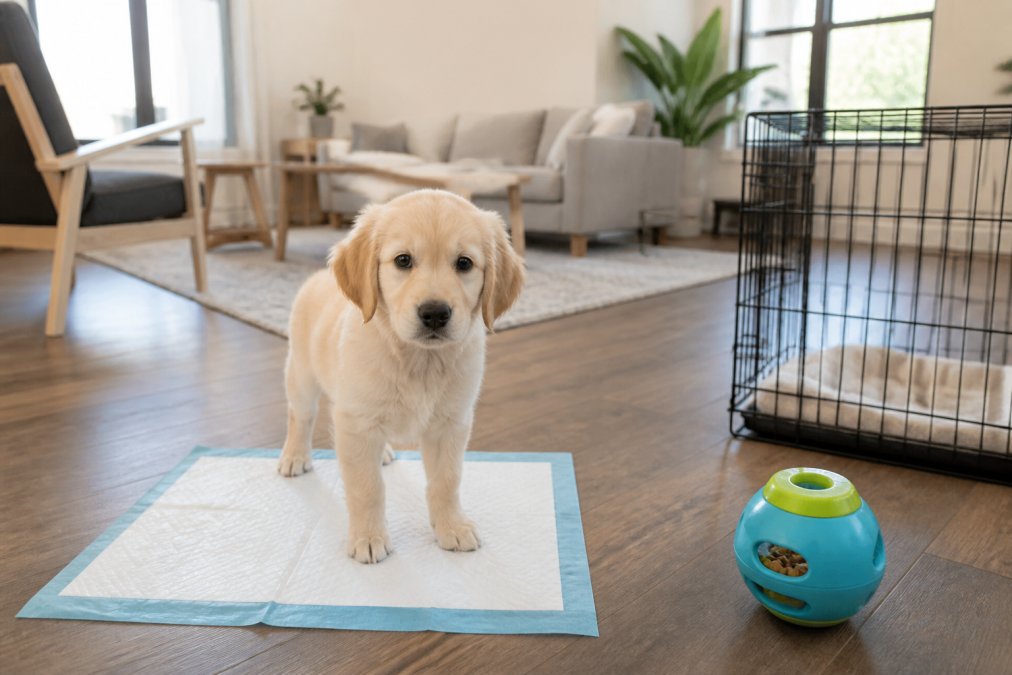
Indoor Relief Stations and Pee Pads
An indoor relief station is a fixed spot inside your home where your dog is allowed to eliminate, usually a pee pad or a patch of artificial turf in a tray. It buys you time on days when a trip outside is not realistic.
Step 3: Apartment Dog Barking Solutions That Work
Apartment dog barking solutions all follow the same logic: find the trigger, then change how your dog feels about it. Punishment does not work here. It usually makes the barking worse, because your dog is already anxious about the noise.
Common triggers in shared buildings:
- Footsteps or voices in the hallway
- The elevator chime
- A neighbor's dog
- Delivery drivers at the door
- Garbage trucks early in the morning
Desensitization for Hallway and Elevator Noise
Desensitization means playing the trigger sound at a low volume while your dog eats or plays. You raise the volume only when your dog stays relaxed. Over weeks, the real hallway noise stops meaning anything.
Step 4: Indoor Dog Exercise Ideas for Small Spaces
Indoor dog exercise ideas work best when they tire the brain, not just the legs. A tired dog is a quiet dog, and mental work drains energy faster than a short walk. But in an apartment, you also have to solve for three things a house with a yard never has to: square footage, floor noise, and neighbors below you.
Brain games that fit a 10-by-10 space
- Sniff-and-find: Hide five to eight treats around one room and release your dog to search. Nose work is the single most efficient energy drain for most dogs, and it needs no floor space.
- Muffin tin puzzle: Drop treats in a muffin tin and cover each cup with a tennis ball. Your dog has to lift the balls to eat. Cheap, quiet, and reusable.
- Cardboard shred box: Put a few treats inside a closed cardboard box and let your dog tear it apart. Supervise, then recycle. Great for dogs that need to destroy something.
- Stair sits and downs: If your building has a quiet stairwell, ten minutes of sit-down-stand repetitions on the landing is real physical work without a hallway sprint.
- Trick training: Shaping a new behavior in five-minute bursts, spin, bow, touch a target, burns as much focus as a walk.
Movement games that won't annoy the downstairs neighbor
Running and fetch in a hallway is where most apartment owners get noise complaints. Swap them for low-impact options:
- Tug on a mat: A soft mat under the play area muffles paws and protects hardwood. Keep tug structured, short pulls, a release cue, then restart.
- Flirt pole: A pole with a lure on the end lets a dog sprint and pivot in a small footprint. Ten minutes is genuinely tiring for most medium-energy dogs.
- Rolled towel game: Roll treats into a bath towel and let your dog unroll it. Quiet, self-soothing, and reusable.
- Indoor fetch with a soft toy: Use a soft or plush toy and throw it low along the floor rather than across the room. Hard toys bouncing off walls are what neighbors hear.
Gear that actually helps in a small space
- Food-dispensing toys (treat balls, puzzle feeders) replace a bowl and turn mealtime into 15 minutes of work.
- Snuffle mats let a dog forage indoors without scattering kibble across the carpet.
- A washable play mat under the training zone cuts both noise and cleanup.
- A flirt pole with a replaceable lure stores behind a door and outlasts most plush toys.
Two or three short sessions beat one long one. Ten minutes here and there adds up, and it fits around a workday. If your dog is still restless after a full day of this, the problem is usually not enough sniffing work, not too little running.
Mental stimulation tires a dog faster than physical exercise. A fifteen-minute brain game often does more for calm behavior than an extra lap around the block, and it won't get you a noise complaint.
Step 5: Crate Training and Urban Etiquette in Shared Spaces
Crate training is the backbone of apartment life. A crate gives your dog a quiet room of its own, and it keeps your dog safe when you cannot watch it.
- Keep your dog on a short leash in shared spaces
- Step aside and sit when someone passes
- Take the stairs if your dog is nervous in elevators
- Never let your dog greet a stranger without asking
- Carry bags and clean up every time
Step 6: Landlord Policies, Neighbor Conflicts, and Apartment Dog Training
Most apartment training guides skip the paperwork. That is a mistake, because a lease problem can undo months of good work, and this is the part of apartment dog ownership almost no competitor covers in detail.
Read the lease before the dog comes home
Before you fall in love with a dog, pull your lease and look for four specific things:
- Pet addendum: A separate signed document that lists the animal, often with a photo and description. Without it, your dog may not be legally allowed in the unit even if the lease mentions pets.
- Pet deposit vs. pet rent: A deposit is usually a one-time refundable amount; pet rent is a recurring monthly charge. Both are common, and they are not the same line item.
- Breed and weight restrictions: Many buildings cap weight (commonly 25-50 lbs) or list restricted breeds. These are set by the landlord or the building's insurer, not by any federal rule.
- Renters insurance requirement: Many leases require a policy that names the pet. Some insurers exclude certain breeds, so confirm coverage before you sign the addendum.
Know the two federal rules that actually apply
The Fair Housing Act requires most landlords to make reasonable accommodations for assistance animals, including waiving no-pet policies and pet deposits, when the animal is a service animal or an emotional support animal with proper documentation. That protection does not extend to ordinary pets. Separately, the Americans with Disabilities Act covers service animals in public accommodations, not in private housing.
Keep a paper trail
Keep a single folder, physical or digital, with:
- Vaccination records and your dog's license if your city requires one
- The signed pet addendum and any deposit receipts
- Your renters insurance declarations page
- A dated log of any neighbor complaints and how you responded
If a neighbor raises an issue, respond in writing and calmly. A short, polite note resolves more conflicts than a hallway argument ever will.
Scripts for the two most common neighbor complaints
Noise complaint about barking. Try something like: "Thanks for letting me know, I didn't realize it was carrying through the wall. I'm working on it with a trainer and I've moved his crate away from the shared wall. If it happens again, a text is the fastest way to reach me." Then actually do the thing you said you'd do.
Breed suitability is worth an honest look
Building size limits often rule out larger dogs regardless of temperament, and some insurers restrict certain breeds. Before you commit, check three things: your building's weight and breed list, your insurer's breed exclusions, and how much daily exercise the breed actually needs. High-drive working breeds, herding and terrier types, often struggle in a 600-square-foot unit not because of size but because of energy.
Renters in buildings with strict pet rules who want training gear that stores flat and moves easily between apartments.
Frequently Asked Questions
What is the 3-3-3 rule for dogs?
The 3-3-3 rule describes a rescue dog's adjustment timeline: 3 days to decompress, 3 weeks to settle into a routine, and 3 months to feel fully at home. In an apartment, this matters because new sounds, elevator rides, and hallway traffic can slow progress. Give your dog quiet space, keep a consistent schedule, and avoid overwhelming introductions during the first three days.
How can I potty train my dog while living in an apartment?
Take your dog out on a fixed schedule, first thing in the morning, after meals, and before bed. Use the same outdoor spot every time so scent marks build familiarity. If you cannot reach the door quickly, set up an indoor relief station with pee pads. Reward every successful potty with praise or a treat within seconds. Clean accidents with an enzymatic cleaner to remove odor that triggers repeat marking.
How do I stop my dog from barking at neighbors in an apartment?
Identify the trigger first, such as hallway footsteps or elevator chimes. Block visual access with window film or furniture, then practice desensitization by playing recordings of those sounds at low volume while rewarding calm behavior. Increase volume gradually over days. For separation anxiety barking, use food-dispensing toys and build alone time in short increments. Consistent, reward-based training reduces barking more reliably than punishment.
What are the best indoor exercise activities for apartment dogs?
Try hallway fetch, stair sprints if your building allows, hide-and-seek with treats, and puzzle toys that require problem-solving. A 15-minute session of brain games like 'find it' or scent work tires a dog as much as a longer walk. Rotate toys weekly to prevent boredom. For high-energy breeds, combine two or three short sessions daily to meet exercise needs without leaving the apartment.
Training a dog in an apartment takes patience, a fixed routine, and gear that fits a small home. Furtastic Pet Essentials makes that easier with a full catalog of crates, bedding, travel gear, and grooming supplies for city pets, plus fast, friendly service when you need a replacement mid-training. Get started with Furtastic Pet Essentials and build a calmer, quieter home for both of you.