

How to Verify Pet Product Safety Certifications
Table of Contents
- Why Verifying Pet Product Safety Certifications Matters
- Understanding CPSC Requirements for Pet Products
- How to Verify Pet Product Safety Certifications: A Step-by-Step Workflow
- Reading and Authenticating Pet Product Test Reports
- Common Hazards and What Safety Testing Should Cover
- Red Flags and How to Spot Misleading Claims
- Frequently Asked Questions
Last Updated: October 5, 2026
Why Verifying Pet Product Safety Certifications Matters
Pet owners want products that are safe, durable, and made with care. But a label that says "certified" or "tested" can mean almost anything.
Many owners assume a product for sale must be safe. Not always: some manufacturers make misleading claims or use vague certifications that prove little.
This guide shows you how to verify pet product safety certifications so you can shop with confidence.
Understanding CPSC Requirements for Pet Products
The Consumer Product Safety Commission (CPSC) oversees product safety in the United States, including pet items. Knowing these requirements helps you check certifications.
Pet products fall under different CPSC rules by type: toys, bedding, and travel gear each have their own standards, and bowls made of certain materials have specific requirements.
Not every pet product requires CPSC certification, but manufacturers must follow safety standards for their category, test for common hazards, and keep records.
How to Verify Pet Product Safety Certifications: A Step-by-Step Workflow
Verifying a safety claim is a document-matching exercise: confirm that a specific report, issued by a specific lab, covers the specific item in front of you. Work through these steps in order and keep a written record.
Step 1: Capture the product's identity before you contact anyone
You cannot verify a claim without a unique identifier. Before you email or call, write down:
- Manufacturer legal name and physical address, not just a brand name. "Furtastic" is a brand; the responsible company is the entity that must keep compliance records.
- Importer or distributor name and address, if imported. Under CPSC rules the importer is treated as the manufacturer for compliance, so this is the party you can hold accountable.
- Model number, SKU, or item number printed on the packaging or the product itself.
- Batch, lot, or date code, often stamped on the item or a hang tag. A report for lot A does not automatically cover lot B if materials or suppliers changed.
- Country of manufacture and the date you purchased it.
If any are missing, treat it as a documentation gap, a legitimate manufacturer can produce all of them on request.
Step 2: Request the right documents, and name them precisely
A vague request gets a vague answer. Ask for these by name:
- The full third-party test report, not a one-page summary or a marketing "certificate of compliance."
- The scope statement, the section that lists which models, materials, and hazards were tested.
- The test method references, the standard or protocol the lab followed (for example, a toy safety standard or a food-contact material standard).
- The report issue date and any revision history.
- The lab's accreditation certificate number, if not printed on the report.
Put the request in writing so you have a dated record. Most legitimate manufacturers respond within days; a refusal, a redirect to a marketing page, or an obvious template are signals to walk away.
Step 3: Confirm the lab is real, independent, and scoped to the test
A lab's name on a report is not proof. Verify three things:
- The lab exists and is independent. Search the lab's name directly, not through a link the manufacturer provided. Confirm it is a separate legal entity, not a division of the manufacturer.
- The lab holds a relevant accreditation. In the U.S., look for accreditation through a recognized body such as an ILAC-recognized accreditor, or recognition as a Nationally Recognized Testing Laboratory (NRTL) where the category calls for it. NRTL recognition is product- and standard-specific, so confirm the lab is recognized for the standard cited in the report, not just in general.
- The accreditation scope covers the test performed. Accreditation certificates list the specific standards a lab is accredited to test against. If the report cites a standard not on that list, the test is outside the lab's accredited scope.
Step 4: Match the report to the exact product in your hand
Most verification attempts fail here: a report is only valid for the configuration it tested. Check each of these against the physical product:
- Model number, must match exactly, including any suffix or revision letter.
- Materials, the report may list "ABS plastic" while the product is now labeled "recycled ABS" or a different polymer. A material change invalidates the prior test.
- Components tested, a report for the toy body does not cover a squeaker, a painted logo, or a sewn-on tag added later.
- Hazards covered, confirm the report addresses the hazards relevant to that category (see the hazards section below). A report that tested only for sharp edges says nothing about chemical safety.
- Date vs. manufacture date, if the report predates a known redesign, or is older than the current production run, treat it as unverified until the manufacturer confirms no changes were made.
Step 5: Record your findings and decide
For each product, record the manufacturer, report number, lab, standard cited, date, and whether the scope matched. That gives you a defensible answer to "is this actually certified?" and a paper trail if you need to report a problem.
If the manufacturer cannot produce a scoped, current, third-party report for the exact product, the honest conclusion is that the safety claim is unverified, not that the product is unsafe, but that the evidence does not exist.
Reading and Authenticating Pet Product Test Reports
Most guides say to "look for red flags," but a convincing fake has none. The reliable method is to read the report against its own structure, then authenticate it with the issuer.
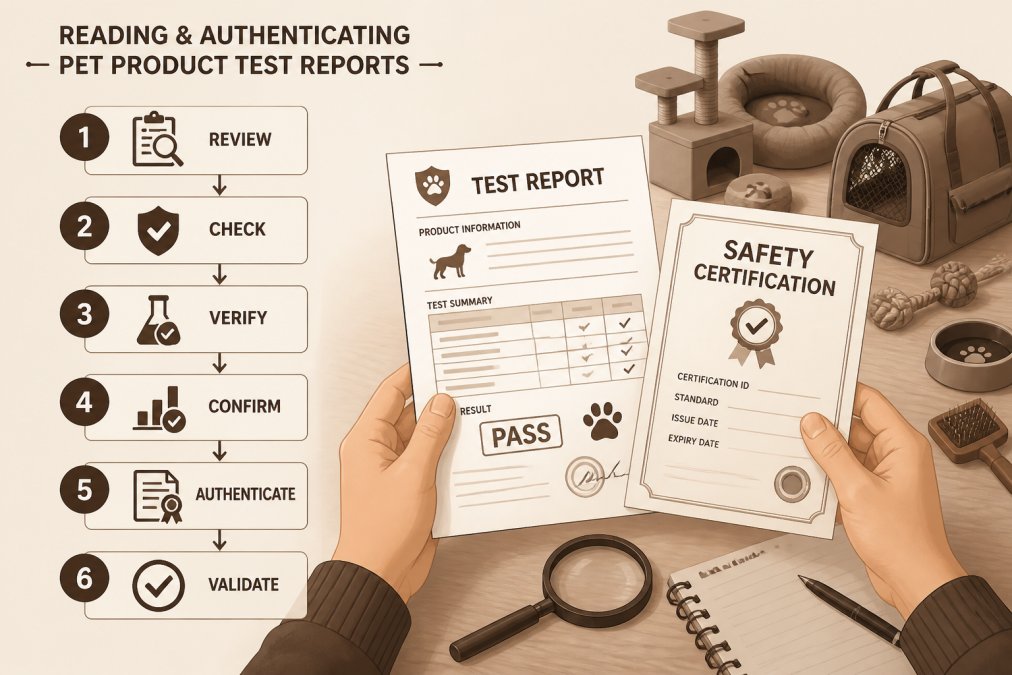
The anatomy of a real test report
A legitimate third-party report is a structured document, not a certificate graphic. Expect these sections:
- Header block: lab legal name, physical address, phone, email, and the accreditation body with the lab's accreditation number.
- Report identifier: a unique report number, plus a revision number if amended. The revision matters, a "Rev 2" supersedes "Rev 1."
- Client and sample identification: who submitted the sample, the product name, model number, and often a photograph or description of the exact sample tested.
- Scope and method: the standard or protocol used, and the specific clauses or test methods applied.
- Results table: pass/fail or measured values per test, with the acceptance criteria stated.
If a document is missing the scope, the method, or the authorization block, it is not a test report, it is a marketing summary.
Authenticating the report with the issuing lab
- Find the lab independently. Search the lab's name and open its own website. Do not use a link, QR code, or phone number printed on the report, those are the easiest things to fake.
- Use the lab's published contact details to reach its report-verification or quality department.
- Ask a closed question: "Did your lab issue report [number], revision [X], for [product/model], dated [date]?" Closed questions are hard to bluff around.
- Ask a second question: "Is the standard cited in that report within your accredited scope?" A lab that issued the test but is not accredited for that standard is a meaningful limitation.
- Request written confirmation by email if the stakes are high (a large purchase, a product for a pet with known allergies, or a supplement).
Red flags that survive a quick glance
These patterns hold up even when a document looks polished:
- Report number that cannot be confirmed by the issuing lab, or a lab with no record of the client.
- Accreditation number that does not appear in the accreditor's public directory, or a scope that excludes the cited standard.
- Scope creep: a report for one model presented as covering an entire product line.
- Stale dates: a report older than the product's current design, with no confirmation that materials and suppliers are unchanged.
- Missing revision history when the product has clearly been updated.
- Pass/fail results with no acceptance criteria, a "pass" means nothing if the threshold is not stated.
Certification, testing, compliance, and marketing claims are not the same thing
These four terms get used interchangeably, but should not be.
- Testing is a lab measuring a sample against a method. It produces a report.
- Compliance is a manufacturer's assertion that a product meets applicable legal requirements. It may be supported by testing, but the assertion itself is not proof.
- Certification is a third-party attestation, usually tied to a specific standard and a specific scope, issued by a body with the authority to certify that standard.
- Marketing claims ("lab tested," "vet approved," "safe materials") are unverified statements until you can trace them to one of the three above.
When a product says "certified," ask: certified by whom, to what standard, for which model, and on what date? If any of those four answers is missing, you have a marketing claim, not a certification.
Common Hazards and What Safety Testing Should Cover
Knowing which hazards pet products face helps you understand what testing should cover.
Choking hazards are a major concern for toys and accessories.
Toxicological hazards involve harmful chemicals or materials. Paint, dyes, plastics, and fillings can contain toxic substances.
Physical hazards include sharp edges, rough surfaces, and weak seams.
Microbiological hazards matter for food and water bowls.
A comprehensive report covers all these categories.
Red Flags and How to Spot Misleading Claims
Manufacturers sometimes use vague language to sound credible without proving safety.
"Lab tested" without details. This phrase means almost nothing. What lab?
"Meets industry standards" without naming the standard. Which standard?
"Certified safe" without a certifying body. Who certified it?
"Made with safe materials" without proof. This is marketing language.
Choosing safe pet products starts with knowing what to look for.
Frequently Asked Questions
What should a legitimate pet product test report include?
A legitimate test report must include the testing laboratory's name and accreditation status, the specific product tested (with model number and batch code), the testing standards applied, test dates, and detailed results for hazards relevant to that product category. For toys, this includes choking hazard, durability, and material safety. For food or water bowls, it covers food-contact material compliance. The report should be signed by an authorized representative and include the laboratory's contact information so you can verify it directly.
How do I check whether a certification applies to the exact product I'm buying?
Certifications are product-specific and batch-specific. Check that the test report lists the exact model number, size, color, and batch code of the item you're purchasing. A certification for one size or color does not automatically apply to another variant. Manufacturers sometimes change materials or design between production runs. Request the current batch code from the retailer and confirm it matches the test documentation. If the product has been updated or redesigned since the test date, ask for updated testing.
What are the CPSC requirements for pet products?
The CPSC enforces safety standards for pet products, including toys, bedding, and accessories. Requirements vary by product category. Pet toys must meet durability and choking-hazard standards; food-contact items must comply with material safety rules; products with small parts must include appropriate warnings. Manufacturers and importers are responsible for compliance and must maintain test documentation. Retailers can be held liable for selling non-compliant products. The CPSC does not pre-approve products, but you can file complaints about unsafe items on the CPSC website.
Are pet products required to have safety certifications?
Not all pet products require third-party certification, but they must comply with applicable CPSC standards and regulations. Manufacturers are responsible for ensuring compliance through testing and documentation, which may be done in-house or by independent laboratories. Some retailers require third-party testing as part of their vendor standards. Certifications from accredited labs provide stronger evidence of compliance than manufacturer claims alone. If a product is marketed as certified or tested, that claim must be backed by actual documentation you can verify.