

Are Bulky Dog Crates Really Necessary for Small Homes?
Last Updated: October 26, 2026
Quick Summary
Foldable metal playpens, pressure-mounted indoor gates, and dog-proofed rooms are the practical alternatives to bulky dog crates in small homes, since each contains your dog without a permanent crate footprint. Match the option to your dog's shoulder height, chew and escape profile, age, and separation anxiety before buying.
- A 49.6-inch square pen occupies about 17 square feet, roughly 4 percent of a 400-square-foot studio.
- Pressure-mounted gates add zero floor space but offer no chew protection and can fail on hollow frames.
- Measure shoulder height, not weight: 30 inches is the practical minimum gate height for most medium and large dogs.
- Puppies under about six months do best in a pen with a waterproof pad, not free run of a proofed room.
- For separation anxiety, choose a proofed room with a camera plus gradual alone-time training, not tighter confinement.
Table of Contents
- Why Bulky Dog Crates Crowd Out Small Homes
- Dog Playpen for Small Spaces: Foldable Panels That Earn Their Floor Space
- Indoor Dog Gates: Containing One Room Instead of Buying a Crate
- Dog-Proof Room Setup: The Zero-Footprint Alternative
- How to Train a Dog to Stay Home Alone Without a Crate
- Matching the Alternative to Your Dog's Size, Temperament, and Chewing Habits
- Side-by-Side Comparison: Space, Cost, and Safety at a Glance
- Safety Limits and Renter-Friendly Setups
- Frequently Asked Questions
Why Bulky Dog Crates Crowd Out Small Homes
A standard wire crate for a medium dog eats up roughly the same floor area as a loveseat, in a studio or one-bedroom apartment, that is furniture you cannot walk around.
The core problem: crates are sized for the dog, not the room.
Below, we cover foldable pens, indoor gates, dog-proofed rooms, and crate-free alone-time training, with the trade-offs of each. Most guides get one thing wrong: they treat "crate alternative" as one category.
Dog Playpen for Small Spaces: Foldable Panels That Earn Their Floor Space
A dog playpen for small spaces works best when the panels fold flat and the footprint shrinks between uses.
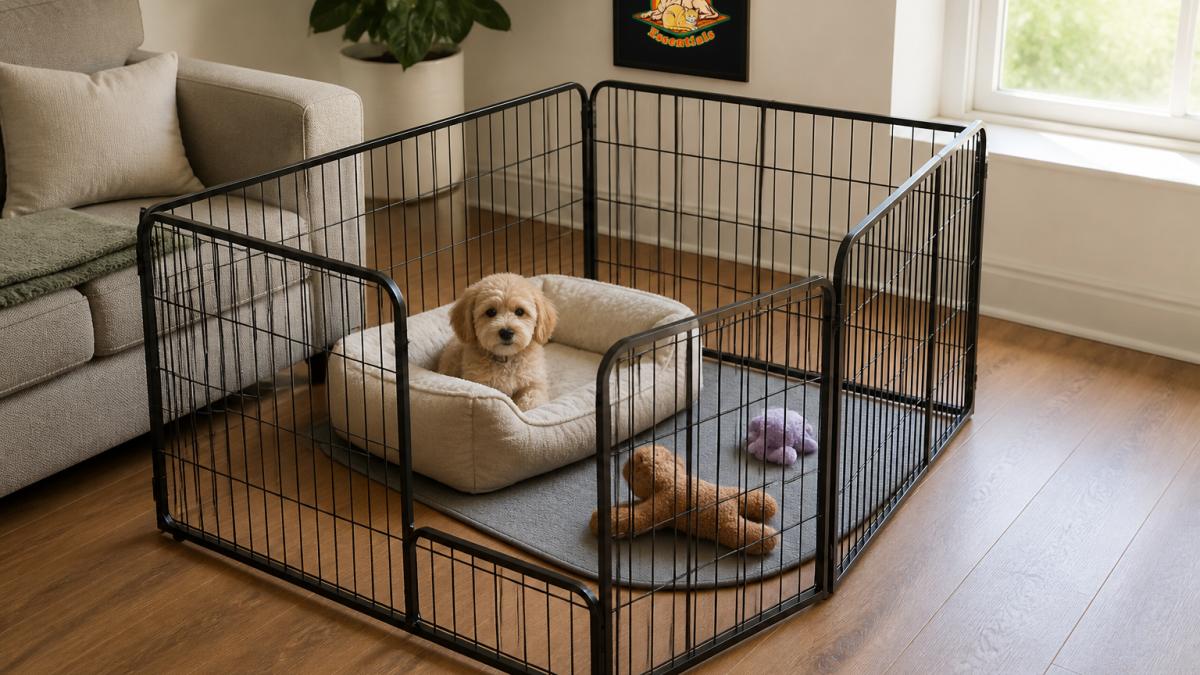
Our BINGOPAWH Heavy Duty Dog Playpen is built exactly for this.
Best for: renters who want containment without a permanent footprint. Skip if: your dog is a determined climber over 34 inches tall at the shoulder.
You can shop the heavy-duty foldable dog playpen to see the panel layout and pad for yourself.

Sizing a Playpen to Your Actual Room
Measure the longest clear wall, subtract door swing, and compare that to the assembled pen. A 49.6-inch square pen needs about 4 feet of clear width. If your room cannot spare it, use fewer panels in a rectangle, or step down to a gate setup.
Indoor Dog Gates: Containing One Room Instead of Buying a Crate
Indoor dog gates contain a whole room rather than a single box, usually costing less floor space than a crate once you count the walkway.
The trade-off: a gate blocks a doorway but does not stop chewing, digging, or counter-jumping.
Watch out: pressure-mounted gates can fail against a determined large dog or a hollow drywall frame. Check the gate's rated width and mounting type before trusting it with a strong dog.
Dog-Proof Room Setup: The Zero-Footprint Alternative
A dog-proof room setup uses space you already have, adding no footprint at all. The catch: "dog-proof" is a verb, not an adjective.
What to Remove, Cover, and Lock Away
- Cords and cables lifted or run through cord covers
- Trash bins with locking lids, or moved behind a closed door
- Medications, supplements, and cleaning products in closed cabinets
Give the room a resting spot so it reads as a den, not a timeout zone. A calming bed with a non-slip base, like our JHK Calming Dog Bed at $40.99, anchors the corner and keeps the bed from sliding on hard floors.

Best for: dogs that are already house-trained and non-destructive. Skip if: your dog is a strong chewer or an escape artist; a room gives them more to work on, not less.
How to Train a Dog to Stay Home Alone Without a Crate
Training a dog to stay home alone without a crate is gradual, built on short absences. Start with minutes, not hours.
- Set up the chosen space with water, a bed, and a safe chew.
- Leave for 5 minutes and return calmly.
- Add 10 minutes per session, only when the last one was quiet.
- Vary departure cues so your leaving does not trigger anxiety.
- Use a camera to watch for pacing, howling, or door scratching.
- Extend to 30 minutes, then an hour, then a normal workday.
A common mistake is rushing the jump from 20 minutes to four hours. If your dog panics at any step, drop back two steps and rebuild. For apartment-specific pacing, our guide on how to train a dog in an apartment walks through the same sequence room by room.
BINGOPAWH Heavy Duty Dog Playpen For Indoor Outdoor Use →
Matching the Alternative to Your Dog's Size, Temperament, and Chewing Habits
Most guides hand you a list and leave the matching to you. The useful version is a decision sequence: start with the dog, then the room, then the budget. Work through these four questions in order and the right option usually falls out.
1. How tall is your dog at the shoulder, and can it clear a barrier?
Measure shoulder height, not weight. A dog standing 22 inches at the shoulder can usually clear a 24-inch gate with a running start; 30 inches is the practical minimum for most medium and large dogs, and 34 to 36 inches is safer for climbers. If your dog has cleared a baby gate before, treat any panel under 36 inches as a suggestion, not a barrier.
2. What is the dog's chew and escape profile?
Be honest here, because this is where soft-sided and plastic options fail. A dog that has destroyed a stuffed toy in under ten minutes, or popped a zipper or pushed through a fabric seam, is a metal-panel dog. Fabric pens and soft crates are travel tools, not alone-time containment, for any dog with a real chew history. For escape artists, check latch style (a safety-latched gate beats a simple hook) and panel-to-panel connection (welded or bolted beats friction-fit).
3. What is the dog's age and house-training status?
- Puppies under about six months: a pen or a proofed room with a waterproof pad, because accidents are guaranteed and you want a surface you can wipe. A gate alone gives a puppy too much room to make mistakes out of sight.
- Adolescent dogs (roughly 6 to 18 months): the highest chew and escape risk of any age. Metal panels, secure latches, and short supervised sessions.
- Adult, house-trained dogs: a gate or a proofed room is usually enough, and it is the lowest-footprint option you can choose.
4. Does the dog show separation anxiety?
This is the question most crate-alternative articles skip, and it changes the answer completely. A dog with true separation anxiety, pacing, howling, door-scratching, drooling within minutes of your leaving, does not need a bigger or smaller enclosure. It needs a gradual alone-time protocol (covered in the training section below) and, in serious cases, a conversation with your veterinarian. Confining an anxious dog more tightly tends to make the panic worse.
Quick matching table
| Dog profile | Best first choice | Avoid |
|---|---|---|
| Small, calm, house-trained | Pressure-mounted gate or proofed room | Overbuilt heavy pens |
| Medium, chews occasionally | Foldable metal pen with safety latch | Fabric pens, soft crates |
| Large or strong | Heavy-duty metal pen, 34+ inch panels | Baby gates, tension gates on drywall |
| Puppy under 6 months | Pen with waterproof pad | Free run of a proofed room |
| Separation anxiety | Proofed room + gradual training + vet consult | Tight confinement |
| Escape artist | Welded/bolted panels, secure latch | Friction-fit panels, zippers |
For dogs that need a soft landing spot inside any setup, an orthopedic bed with a washable cover supports joints and cleans up easily. The JHK Orthopedic Dog Bed at $71.99 fits that role.

Side-by-Side Comparison: Space, Cost, and Safety at a Glance
This is the section most crate-alternative guides skip: an actual comparison across the dimensions that matter in a small home, footprint, storage, setup time, rental damage, and realistic cost. The numbers below are planning estimates, not product specs, so measure your own room before you buy.
The comparison table
| Option | Assembled footprint | Stored footprint | Setup time | Rental damage risk | Typical cost range | Best for | Main limit |
|---|---|---|---|---|---|---|---|
| Foldable metal playpen | Roughly 16 to 25 sq ft for a 4- to 5-foot square | Folds flat to a few inches thick | 2 to 10 minutes | None (floor-standing) | $100 to $250 | Renters, puppies, medium chewers | Height cap for climbers |
| Pressure-mounted gate | Doorway only (0 added floor) | Removes in seconds | Under 1 minute | None if pressure-mounted | $30 to $120 | Calm, house-trained dogs | No chew protection; can fail on hollow frames |
| Hardware-mounted gate | Doorway only | Stays installed | 15 to 30 minutes once | Screw holes in frame | $50 to $150 | Strong dogs, permanent setups | Landlord approval needed |
| Proofed room | Zero added | Zero | 1 to 2 hours once, then maintenance | Low if cords and floors protected | Under $50 in covers and locks | House-trained, non-destructive dogs | More room to damage |
| Soft-sided pen or crate | Small, roughly 6 to 12 sq ft | Folds flat | Under 5 minutes | None | $40 to $120 | Travel and short trips only | Fails against chewers |
| Supervised tether | A few sq ft | Coils up | Under 1 minute | Anchor point may mark trim | $10 to $40 | Grooming, vet waits, short supervised holds | Never for unsupervised use |
How to read the footprint column
A 49.6-inch square pen, like the BINGOPAWH Heavy Duty Dog Playpen, occupies about 17 square feet assembled, roughly 4 percent of a 400-square-foot studio, but far less than a loveseat-sized crate once you account for the walkway a crate forces you to leave. The trick is placement: a pen in a corner uses two walls as free boundaries, while a freestanding crate in the middle of a room wastes clearance on all four sides.
Sample layouts for small homes
- Studio, one dog, one wall: pen in a corner against two walls, bed inside, gate across the kitchen doorway for daytime separation. Total added footprint: about 17 square feet.
- One-bedroom, puppy: pen in the bedroom corner for night, pressure-mounted gate on the bedroom door for daytime, proofed living room as the free-roam goal. Total added footprint: about 17 square feet plus a doorway.
- Tiny home or RV: no pen; pressure-mounted gate plus a proofed sleeping nook. Added footprint: effectively zero, but supervision requirements go up.
Cost and long-term value
The cheapest option is not always the gate. A $40 pressure gate that fails against a strong dog and gets replaced twice costs more than a $160 metal pen that lasts. Metal panels are the most durable per dollar for chewers; fabric options are cheapest upfront and shortest-lived. Budget for one replacement cycle on any soft-sided product if your dog is young or mouthy.
That table is the short version. The longer version: the right answer for a 400-square-foot studio with a calm adult dog is almost never the right answer for a 900-square-foot apartment with an adolescent chewer.
Safety Limits and Renter-Friendly Setups
Safety limits matter more than product claims. No pen, gate, or proofed room replaces supervision for a puppy or a dog with a known escape habit.
For renters, the priority is damage-free installation. Pressure-mounted gates leave no holes; foldable pens sit on the floor with no fixings; a waterproof pad under the pen protects hardwood and your security deposit.
Ventilation and visibility matter too. Metal panel pens let air move and let your dog see the room, reducing stress compared with a closed plastic kennel.
Frequently Asked Questions
Is a playpen a good alternative to a dog crate?
A playpen gives your dog more room to move, stretch, and play than a crate while still keeping them contained. For small homes, a folding panel playpen like the BINGOPAWH Heavy Duty Dog Playpen ($160.99) collapses flat when not in use and forms a 49.6 by 49.6 inch area with 34.6 inch tall panels. Playpens suit dogs that settle well but need boundaries. They are not escape-proof for determined jumpers or strong chewers, so match the height and latch strength to your dog.
Can indoor dog gates keep a dog safely in one room?
Yes, when the room itself is dog-proofed. Indoor dog gates block doorways and stairs so your dog stays in a prepared space instead of a crate. Walk the room first: cover outlets, move cords, secure trash, and remove anything chewable. Gates work best for dogs that do not jump or climb. For jumpers, choose a taller gate or switch to a ceiling-height playpen. Always test the gate's pressure or hardware mount so a pushy dog cannot shove it loose.
How do you train a dog to stay home alone without a crate?
Build alone time in short increments. Start with five minutes in a dog-proofed room while you are home, then step out for brief absences and lengthen them gradually. Leave a familiar bed and a safe chew toy, and return before your dog shows distress. Most dogs adjust over several weeks of daily practice. Skip this route for puppies under six months or dogs with separation anxiety, and talk to your vet before leaving a anxious dog loose unsupervised.
What are the best alternatives to bulky dog crates in a small home?
The four workable options are a folding playpen, indoor dog gates paired with a dog-proofed room, a designated dog area with a bed and tether station, and a soft-sided or collapsible crate for travel. Each trades some containment strength for floor space. A playpen folds flat for storage, gates use a doorway you already have, and a dog-proof room costs nothing beyond safety prep. Pick based on your dog's size, chewing habits, and how much supervision the setup gets.
At what age should you stop crating a dog?
Many owners begin phasing out the crate once a dog reliably holds bladder control and settles calmly alone, often around 18 to 24 months for larger breeds and earlier for small ones. The better signal is behavior: no destructive chewing, no house soiling, and calm behavior when left. Transition gradually by leaving the crate door open, then offering a dog-proofed room for short absences. Keep the crate available as a familiar resting spot even after the door stays open.
The real challenge is not finding a crate alternative; it is matching one to your room, your lease, and your dog's habits without guessing. At Furtastic Pet Essentials, we stock foldable playpens, calming and orthopedic beds, and the everyday essentials that make a crate-free setup actually work, backed by fast, friendly service and a catalog built for real homes. Get started with Furtastic Pet Essentials and build a containment setup that fits your space instead of fighting it.
